


Anyang Qunzhi Machine Tool, formerly known as bosheng Machine Tool, has been established for more than 10 years. It now covers an area of 150,00 square meters and has more than 70 senior technicians and more than 300 technical personnel of various types.
It is a comprehensive machine tool manufacturing enterprise integrating machine tool R&D, manufacturing and technical consulting services.
Wide Range Of Application
Our products are used in many fields, such as Aviation, automobiles, ships, agricultural machinery, steel, engineering machinery, military industry, mining machinery, railway locomotives, mechanical processing, etc
One-Stop Service
- Pre-sales
We will select the machine tool model according to the customer's needs, confirm the technical agreement with the customer, and complete the customer quotation
- During sale
Track the details of machine tool purchase parts and workshop production and assembly details.
- After-sales
After receiving the user's fault report, the technicians will communicate online and provide a response within 24 hours and a solution within 48 hours.
Professional Technical Team
We have more than 70 professional technical engineers to provide professional services.
Advanced Equipment
We have professional equipment, such as Boring and milling machining center, CNC grinder, etc.
Mill-turn techniques combine the best of a mill and a lathe. A mill-turn center is essentially a hybrid machine that uses the tool rotation of milling and the workpiece rotation of turning. Mill-turn allows users to machine more complex parts without switching machining centers and in much less time. The average mill-turn center can complete four operations to every one performed by a mill or lathe. This process is best for complex parts that would require milling and turning both.
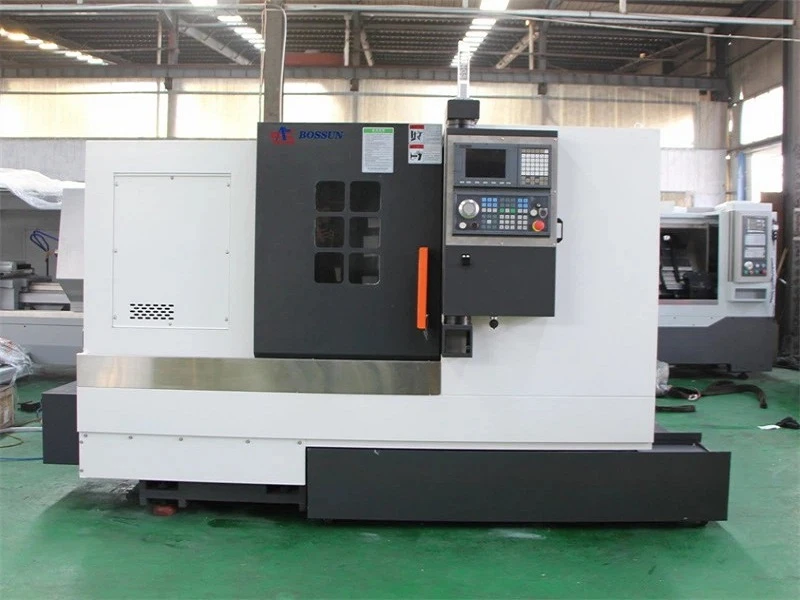
The ultra-high-precision curved gear clutch is used to precisely position the cutterhead to ensure sufficient turret rigidity, stability and durability under any cutting situation.

The electric spindle drive device has the advantages of small inertia, fast response, high power, high speed, high precision, and low noise. The spindle has a built-in encoder to achieve precise positioning and comes standard with the C-axis function.

Milling,Drilling And CNC Lathe
The horizontal turning center is a three-axis linkage, semi-closed-loop control, with C-axis indexing function and equipped with a power tool holder, with milling, drilling, tapping and other functions;
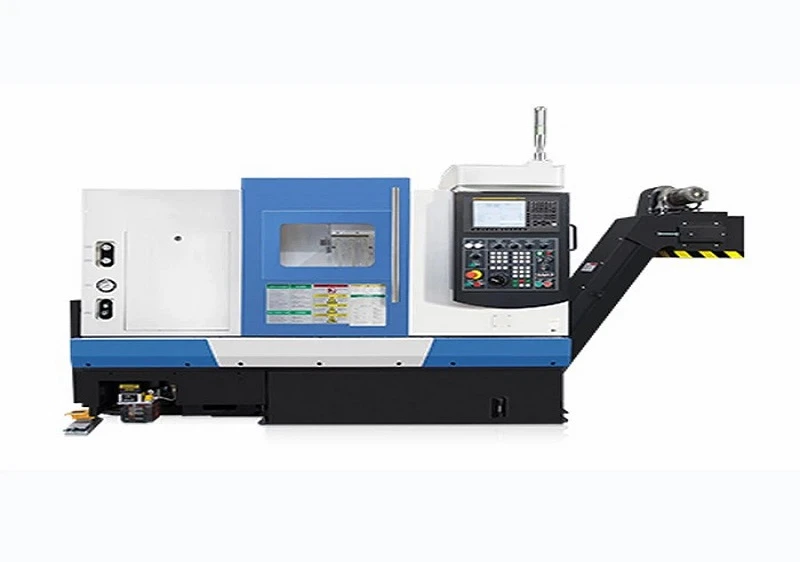
The main unit structure is optimized through structural analysis, and the dynamic rigidity of the bed is maintained during heavy cutting by reducing the height of the equipment;

5 Degree Inclined Bed Heavy Metal Equipment
The X/Z axis screws are all pre-stretched structures, which can reduce the impact of temperature rise on screw accuracy during processing, and use high-speed and silent ball screws;
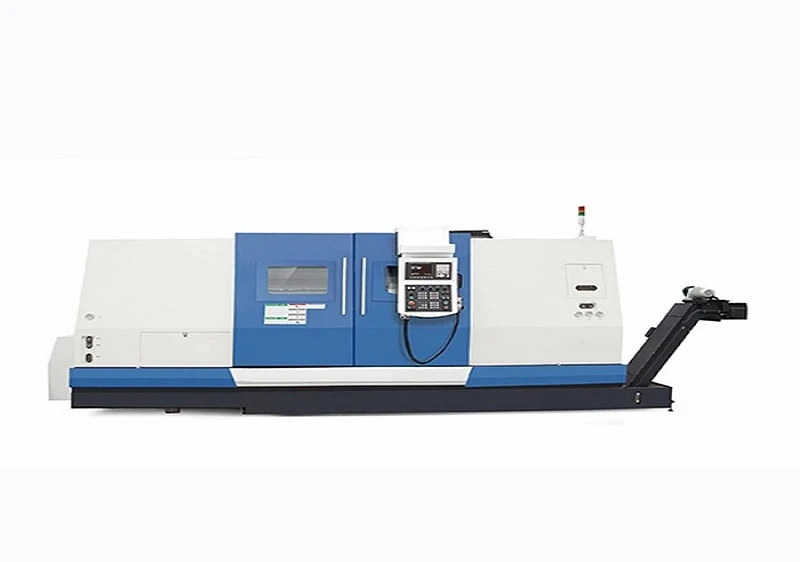
Efficient Turning And Milling Center
It can achieve up to four-axis linkage of X, Y, Z, and C, and can process eccentric holes and mill wide slots and can be configured with dual spindles, dual tool holders, and programmable servo tailstock.

Pipe thread lathes have a variety of spindle diameters for a wide range of applications, and can provide a variety of hydraulic center frames.

The overall bed of Tilt CNC lathe has an inclined structure, which has good rigidity and stability, and has higher rapid movement speed and efficiency.

The linear guide CNC lathe is designed with an overall tilt of 45°, which has the characteristics of high rigidity and smoother cutting.
Increased Productivity
The turn-mill center can perform multiple operations in a single setup, which helps reduce cycle times and increase productivity. It eliminates the need for various setups, which is time saving and reduces the risk of errors.
High Precision
Turn-mill center machines are exact, thanks to their advanced CNC systems. The devices can hold tight tolerances and produce parts with a high degree of accuracy.
Flexibility
The turn-mill center is a highly versatile machine that can perform a wide range of operations. It can handle complex parts with multiple features and shapes, making it a popular choice in the aerospace, medical, and automotive industries.
Cost-effective
The turn-mill center can produce complex parts in a single setup, reducing the need for multiple machines and setups. This helps to reduce costs associated with labour, materials, and production time.
Improved Quality
The turn-mill centre's advanced technology helps to improve the quality of parts produced. It eliminates the risk of errors and has highly accurate and consistent features.
Reduced Lead Times
Turn-mill center machines can produce parts quickly, reducing lead times and improving overall production efficiency.
Improved Safety
The turn-mill center's advanced CNC systems help to improve safety in the manufacturing process. The machines can detect errors and stop the process before any accidents occur.
Types of Turn-mill Centers (Horizontal and Vertical)
There are two types of turning centers: Horizontal and Vertical. Each type has advantages and disadvantages that should be considered when choosing a machine for a particular application.
Horizontal Machining Center are more versatile than vertical ones because they can perform horizontal and vertical machining operations. However, they are also more expensive and occupy more floor space.
Vertical turning centers are less expensive and take up less floor space than horizontal ones, but they can only perform vertical machining operations
Advantages of Turn Mills
Improvised Component design
Component designers can now envision intricate geometries, complex contours, and multifaceted features that were difficult to achieve with traditional methods. The advanced CNC controls and cutting-edge tooling systems produce the design with high accuracy and precision. Surface finishes can be enhanced, tolerances can be tightened, and intricate details can be captured, enabling the creation of high-quality components that meet the expected standards.
Operator Security
The Turning Mills offer several advantages, including prioritising operator security and ensuring a safe and efficient environment. It is equipped with advanced safety systems and interlocks, preventing accidental or unauthorised access to machining. It has user-friendly interfaces that provide clear and concise instructions that operations can follow confidently and ensure safety. The integration of automated features into turn mills further enhances operator security. This reduces direct human intervention in specific hazardous processes during machining, which avoids injuries.
Better Surface Finish
Minimum tool vibration and chatter are two key aspects of turn mills. By leveraging cutting-edge tooling systems and CNC controls, turn mills provide optimal stability and contribute to a smoother surface. The simultaneous machining enables precise material removal and surface contouring. The finished components exhibit a higher degree of accuracy and smoothness.
Material compatibility
Turn mills can handle a diverse range of materials, such as alloys, metals, and composites. With a wide array of cutting tools specific to different materials, Turn-mills ensure enhanced machining performance and prolonged tool life. Manufacturers can confidently work with various materials by using Turn mills, attaining consistent and reliable results across their production lines.
High Accuracy and Precision
The live tooling capabilities of turn-mills enable fly adjustments and intricate operations without the need for time-consuming tool changes. This dynamic functionality allows for fine-tuning and precise contouring. The robust construction enables exceptional rigidity and stability in turn-mills, contributing to their ability to uphold high accuracy and precision.
Reduction in Cost
Turn mills are cost-effective investments as they perform multiple operations on a single machine. Manufacturers can optimise floor space and reduce manpower, which contributes to saving space and capital. Turn-mills also optimise tool life and inventory management, which results in extended tool life and reduced tooling costs.
Lower Usage of Secondary Operations
The versatility of Turn mills empowers manufacturers to achieve complex part geometries in one step. You can perform multiple operations simultaneously, reducing cycle times and improving productivity. By integrating turning and milling functions into a single setup, parts are machined continuously, minimising the requirement for additional operations to achieve the desired end product.
Extended Tool Life
Due to the integration of Turn and milling operations, machining eliminates the need for frequent tool changes. The reduced heat generation during machining is also a significant factor in extending tool life. The integration of coolant systems in Turn-mills further enhances tool life. This combination of lubrication and cooling reduces tool wear and enhances durability during demanding machining tasks.
Enhanced Efficiency and Productivity
Equipped with advanced computer numerical control (CNC) systems and cutting-edge tooling, Turn mills ensure consistently precise and intricate operations. Integrating turning and milling minimises errors associated with the workpiece during repositing. As a result, the machine is set for high productivity and efficiency.
Flexible Small Batch Production
Using Turn mills for flexible small-batch production, you can optimise resource utilisation and minimise material waste. Traditionally, small batch production often poses challenges in terms of cost due to frequent setups and changeovers. Turn mills address this issue by streamlining the process, which enables efficiency and also reduces labour.

Applications Of CNC Mill-Turn Technology
Aerospace
CNC mill-turn machines can help in the manufacturing of airplane and satellite components.
Medical
The medical industry is not new to CNC machining, and manufacturers often turn to CNC mill-turn centers for implants and prostheses, and other medical equipment with similarly complex designs.
Automotive
Steering equipment, engine components, and shafts are typical parts that manufacturers use CNC mill-turn centers to create.
Electronics
Complex electronic hardware parts, like motherboards, circuit boards, and amplifier housings, usually require a high degree of precision and accuracy to manufacture. As CNC turning milling parts usually guarantee this level of precision and accuracy, mill-turn operations are common in the electronics industry.
Energy
The oil and gas industry utilizes CNC mill-turn machining for parts that ensure the proper flow of fuel. Also, nuclear power plants often require complex parts with low tolerance limits, and CNC mill-turn machines can help accomplish this.
Our Factory
Common Problems of Turn Mill Center
Hot Tags: turn mill center, China turn mill center suppliers, factory, Turn Mill Center, Moving Beam Pentahedral Machining Center, Large Doubie Column CNC Vertical Lathe, Double Column Vertical Lathe, Vertical Machining Center, Linear Guide CNC Lathe