

Anyang Qunzhi Machine Tool, formerly known as bosheng Machine Tool, has been established for more than 10 years. It now covers an area of 150,00 square meters and has more than 70 senior technicians and more than 300 technical personnel of various types.
It is a comprehensive machine tool manufacturing enterprise integrating machine tool R&D, manufacturing and technical consulting services.
Wide Range Of Application
Our products are used in many fields, such as Aviation, automobiles, ships, agricultural machinery, steel, engineering machinery, military industry, mining machinery, railway locomotives, mechanical processing, etc.
One-Stop Service
- Pre-sales
We will select the machine tool model according to the customer's needs, confirm the technical agreement with the customer, and complete the customer quotation
- During sale
Track the details of machine tool purchase parts and workshop production and assembly details.
- After-sales
After receiving the user's fault report, the technicians will communicate online and provide a response within 24 hours and a solution within 48 hours.
Professional Technical Team
We have more than 70 professional technical engineers to provide professional services.
Advanced Equipment
We have professional equipment, such as Boring and milling machining center, CNC grinder, etc.
A CNC lathe(CNC turning machine) is a machine that spins material around a central spindle and a fixed cutting tool. Instead of being controlled by physical labor, the movement of your components is determined by coded instructions fed to a computer. Multiple stages may be set simultaneously, avoiding the need for your component to leave the lathe between producing and ensuring accurate cut placement.


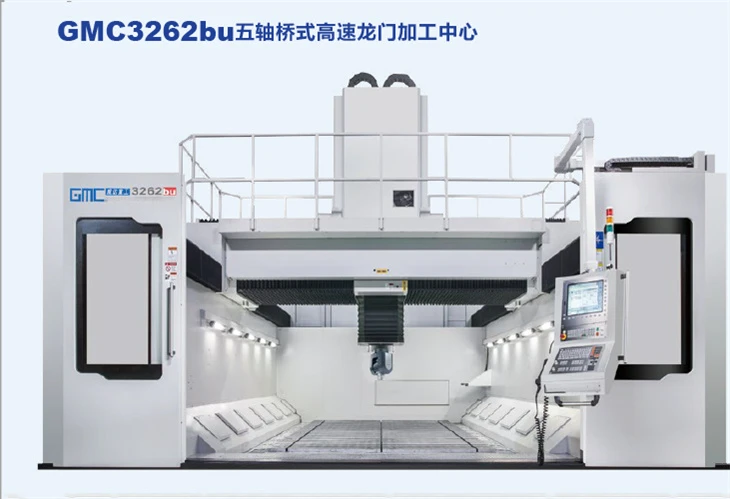
A portal machine is a gantry that is secured on two columns or walls. In some machines, it is the gantry that moves and in others, the gantry is fixed and the table moves underneath it. At least two axes are located on the gantry, the Y and the Z, and in the moving gantry machine the X-axis as well. Depending on the size and type of the machine, two or three additional axes can be added to the machine. If the workpiece is relatively small, it is more convenient to move the part. So, there would be one or two axes on the table manipulating the workpiece and the 3-axis cartesian mechanism moving above it. As the workpiece gets larger, manipulating it becomes more difficult, so we go with a different approach and try to place the part on a solid table and have the gantry with the additional rotary axes moving above it.
What are the Advantages of CNC Milling?
One of the biggest advantages of using CNC milling machines is that they can create parts exactly to specification. Because CNC mills rely on computer instructions to fabricate parts, they eliminate the possibility of human error common in manually operated machines. This means you can accurately create complex parts while achieving tolerances as tight as 0.004mm.
Conventional milling machines often require an operator to manually change cutting tools depending on the cutting operation to be performed. Not only is this time-consuming, but it is also inefficient as end results are based on the operator’s judgment.
CNC mills feature rotating carousels that can hold up to 30 different tools. These tools are automatically exchanged on the spindle during machining operations, allowing cutting operations to be performed quickly and efficiently. With CNC mills, you can have your parts ready in a matter of hours, whereas conventional methods may take days (or weeks) to complete.
CNC mills boast compatibility with a wide range of materials, including plastics, metals, and composites. So long as you’ve got blocks of the material, CNC mills will have no problem machining it.
CNC milling is among the most affordable modern-day manufacturing processes. In fact, a CNC milled component would cost you less than a comparable 3D printed part.
Features of CNC milling machines
It helps scanner, engraving work, recesses, and cuts in metal blanks perform. Eventually, all manipulations serve automatically according to the specific parameters (the product drawing, the depth, and the size of the amounts included in the program).
Subsequently, the cutting element in 3D machines is a saw with many small and robust teeth. The grinding method is standard in the manufacture of car spare parts. However, It can ensure the smoothness of the workpiece.
Metal processing on a 3D CNC milling machine is performed based on a 3D model of a part and its workpiece pre-model on a computer. Hence, the technology allows you to set 3D, more precise engraving settings for future details. Round milling is performed using laser and grinding methods.
How Does CNC Milling Work?

The CNC milling process works by the machine reading coded instructions and then putting them into operation. It all starts with developing a 3D CAD file representing the final part. Once completed, the design is converted into a machine-readable format.
CAM (Computer-Aided Manufacturing) software then exports this to a CNC machine program, usually in G-code format, which acts as the instructions, directing every move that the machine makes. This replicates the CAD design in the chosen material with high accuracy and efficiency.
Using subtractive machining technology, CNC milling can produce high and low volumes of highly complex and intricate parts.
Material is removed from a blank workpiece, and the milling machine uses a rotating cylindrical tool called a milling cutter. Depending on the milling machine being used, the machine can cut in different angles and move along different axes.
The final part will have first been designed via CAD, or Computer-Aided Design, before being inputted into the milling machine for final production.
Applications of CNC Milling
Aerospace
CNC milling plays a vital role in the manufacture of aerospace components and standardizes this process. Aerospace equipment uses a variety of hard metals and special materials to manufacture parts with functions ranging from decorative to critical. CNC milling can better complete difficult-to-machine materials, such as Inconel, a nickel-chromium high-temperature alloy. Milling is also essential for manufacturing precise steering equipment.
Agriculture
The machining shop also uses CNC milling to manufacture many parts used in agricultural equipment manufacturing. With large-scale and short-term production capabilities, it can produce general-purpose parts and unique components for special case equipment.
Automotive
As one of the largest industries in the world, electronic products benefit greatly from CNC machining. The versatility and accuracy of this technology make CNC milling machines and lathes particularly suitable for shaping various plastic polymers, as well as conductive metals and non-conductive dielectric materials.
Motherboards and other electronic hardware require precise configuration to provide fast and complex performance. Milling can create tiny engraved figures, precision machined and machined depressions and holes, and other complex features of electronic parts.
Energy
The energy industry uses CNC milling to mass-produce components for various applications. Nuclear power plants require very fine parts, and the natural gas and oil industries also rely on CNC machining to produce parts that keep the fuel flowing. Hydropower, solar and wind energy suppliers also use CNC milling and turning to manufacture system components that ensure continuous power generation.
Another industry that requires tight tolerances for safety-critical applications of CNC lathes is the oil and gas industry. The department uses CNC milling machines to manufacture precise and reliable parts such as pistons, cylinders, rods, pins and valves.
These parts are usually used in pipelines or oil refineries. They may need a small amount to fit a specific quantity. The oil and gas industry often requires corrosion-resistant machinable metals, such as 5052 aluminum.
Medical
Medical manufacturers use CNC milling machines and lathes to manufacture necessary medical equipment and tools, including prostheses that require precise and unique designs.
CNC milling enables medical equipment to retain precise design features on a variety of metal and plastic substrates, as well as to quickly create components and products, so the company can stay ahead of the medical technology curve.
Since this process is suitable for one-off customized parts, it has many applications in the medical industry. The tight tolerances provided by CNC machining are essential for the high performance of machining medical components.
Military
Modern CNC milling machines can be traced back to the early manual machine tools 200 years ago, which produced uniform weapon parts for the military in batches. This tradition continues as the defense industry uses CNC milling and turning techniques to manufacture prototypes and mass-produced parts. Many of these machined parts have migrated to other industries, and innovations originally developed for military applications now benefit aerospace, electronics, medical, and other industries.
Automation
Mechanical automation and intelligence are becoming more and more popular. Many automation industries need to be designed and customized according to customer requirements to meet the different needs of customers. All technologies require precision to work properly. CNC milling machines follow the design to the final details. This ensures that products with multiple parts and layers can be assembled quickly without errors or misalignments.
At the same time, CNC milling is fast and convenient. You only need to set up the machine to quickly complete the milling of parts according to the settings. CNC can also create various replacement parts. This is because the turnaround time is fast and there is no minimum required number of parts.
At present, the application of CNC milling machine is very wide, and the digital control system is integrated in the ordinary milling machine, which can carry out the milling process more accurately under the control of the program code.
According to the technical requirements of part shape, size, accuracy and surface roughness, the processing technology is formulated, and the processing parameters are selected. Input the programmed machining program to the controller through manual programming or automatic programming with CAM software. After the controller processes the machining program, it sends commands to the servo device. The servo device sends a control signal to the servo motor. The spindle motor rotates the tool, and the servo motors in X, Y and Z directions control the relative movement of the tool and the work piece according to a certain trajectory, so as to realize the cutting of the work piece.
CNC milling machine is mainly composed of bed, milling head, vertical table, horizontal saddle, lifting table, electrical control system, etc. It can complete basic milling, boring, drilling, tapping and automatic work cycles, and can process various complex cams, templates and mold parts, etc.
The bed of the CNC milling machine is fixed on the base, which is used to install and support the various parts of the machine tool. The vertical worktable and the horizontal slide are installed on the lifting table, and the X, Y, Z coordinate feeding is completed by the driving of the longitudinal feed servo motor, the lateral feed servo motor and the vertical lift feed servo motor. The electrical cabinet is installed behind the bed column, which houses the electrical control part.
Point Control Function
The point control of the CNC milling machine is mainly used for hole processing of workpiece, such as center drilling positioning, drilling, reaming, countersinking, reaming and boring.
Continuous Control Function
Mill the plane and surface of the workpiece through linear interpolation, arc interpolation or complex curve interpolation movement of the CNC milling machine.
Tool Radius Compensation Function
If you directly program the workpiece contour line, the actual contour linear will be increased by one tool radius value when processing the internal contour of the workpiece; when the external contour of the workpiece is processed, the actual contour line will be reduced by one tool radius value. Using the tool radius value compensation method, the CNC system automatically calculates the tool center trajectory, deviates the tool center from the workpiece contour by a tool radius value, and processes a contour that meets the requirements of the drawing. Using the tool radius compensation function, changing the tool radius compensation amount can also compensate the tool wear amount and machining error, and realize the rough machining and finishing of the workpiece.
Tool Length Compensation Function
Changing the compensation amount of the tool length can compensate the length deviation value after the tool is changed, and it can also change the plane position of the cutting process and control the axial positioning accuracy of the tool
Fixed Cycle Processing Function
The application of fixed cycle processing instructions can simplify the processing program and reduce the programming workload.
Subroutine Function
If the workpiece is processed in the same or similar shape, it is written into a subroutine and called by the main program, which simplifies the program structure. The function of quoting subroutines makes the machining program modular. It is divided into several modules according to the procedures of the machining process, which are written into subroutines and called by the main program to the processing of the workpiece. This modular program is easy to debug and optimize the process.
Our Factory
Common Problems of CNC Portal Mill
As one of the most professional CNC portal mill suppliers in China, we're featured by quality products and competitive price. Please rest assured to buy CNC portal mill for sale here from our factory. Also, customized service is available.
Gantry Pentahedron Machining Center, Double Column Vertical Lathe, Singie Column Vertical Lathe