


Anyang Qunzhi Machine Tool, formerly known as bosheng Machine Tool, has been established for more than 10 years. It now covers an area of 150,00 square meters and has more than 70 senior technicians and more than 300 technical personnel of various types.
It is a comprehensive machine tool manufacturing enterprise integrating machine tool R&D, manufacturing and technical consulting services.
Wide Range Of Application
Our products are used in many fields, such as Aviation, automobiles, ships, agricultural machinery, steel, engineering machinery, military industry, mining machinery, railway locomotives, mechanical processing, etc
One-Stop Service
- Pre-sales
We will select the machine tool model according to the customer's needs, confirm the technical agreement with the customer, and complete the customer quotation
- During sale
Track the details of machine tool purchase parts and workshop production and assembly details.
- After-sales
After receiving the user's fault report, the technicians will communicate online and provide a response within 24 hours and a solution within 48 hours.
Professional Technical Team
We have more than 70 professional technical engineers to provide professional services.
Advanced Equipment
We have professional equipment, such as Boring and milling machining center, CNC grinder, etc.
A turning center is also known as a CNC lathe. It is a machine that rotates a workpiece on a shaft so that a series of machining processes can be performed on it. Unlike the conventional semi-auto turning lathes, the turning centers are a more advanced machine tool. With the powerful auxiliary equipment such as quick tool changer (QTC), automatic tool changer (ATC), secondary spindle, and the CNC system, etc. they are capable of conducting various machining operations, such as cutting, knurling, and grinding.
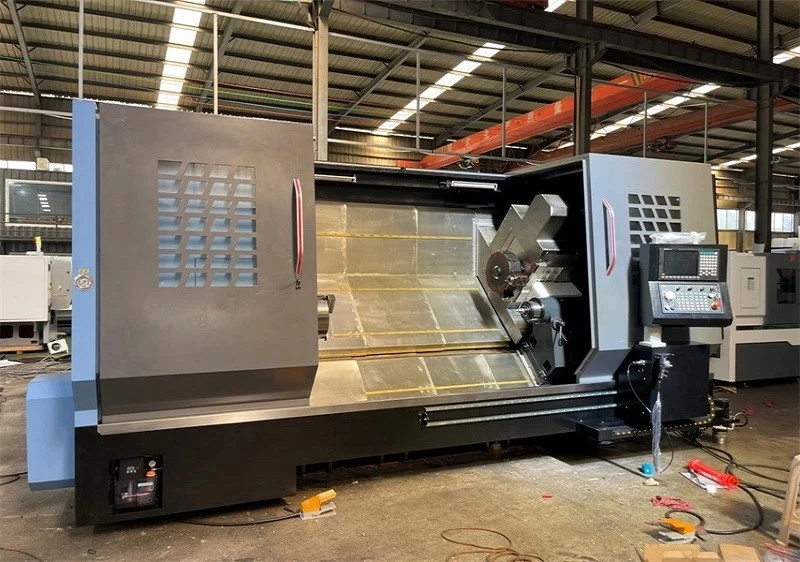
Milling, Drilling And CNC Lathe
The horizontal turning center is a three-axis linkage, semi-closed-loop control, with C-axis indexing function and equipped with a power tool holder, with milling, drilling, tapping and other functions;
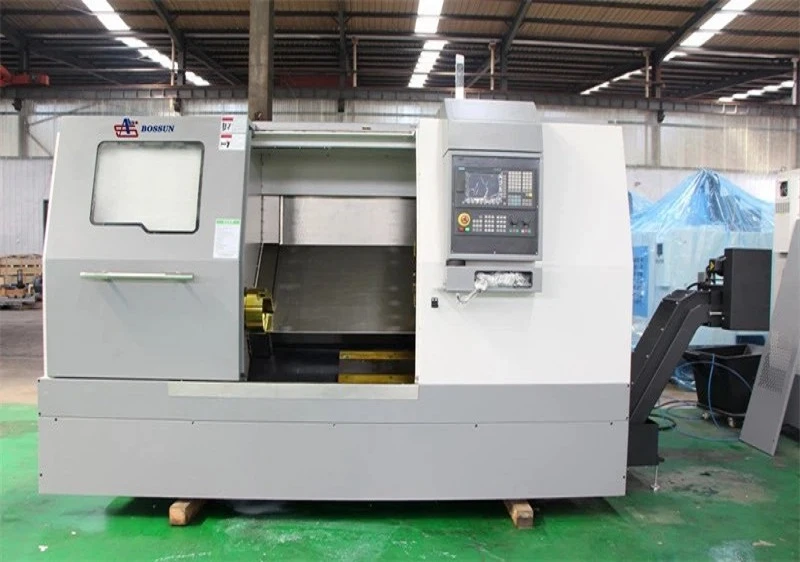
The electric spindle drive device has the advantages of small inertia, fast response, high power, high speed, high precision, and low noise. The spindle has a built-in encoder to achieve precise positioning and comes standard with the C-axis function.
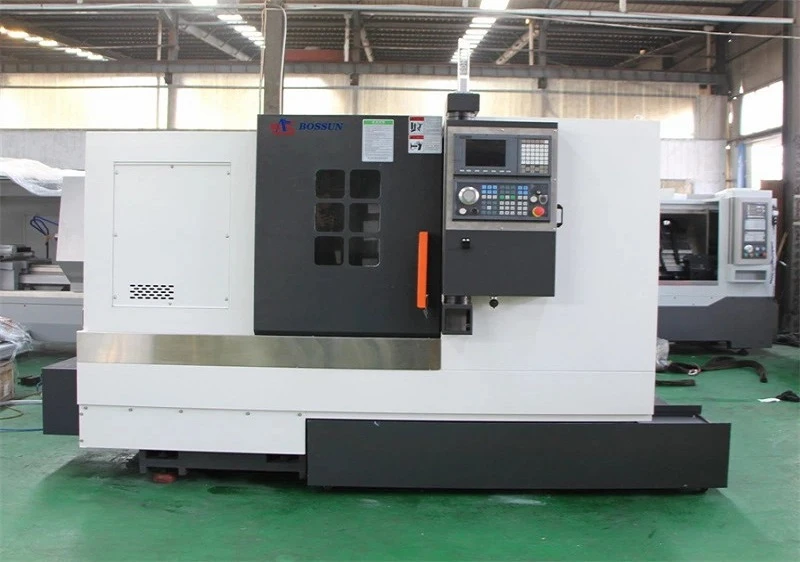
The ultra-high-precision curved gear clutch is used to precisely position the cutterhead to ensure sufficient turret rigidity, stability and durability under any cutting situation.
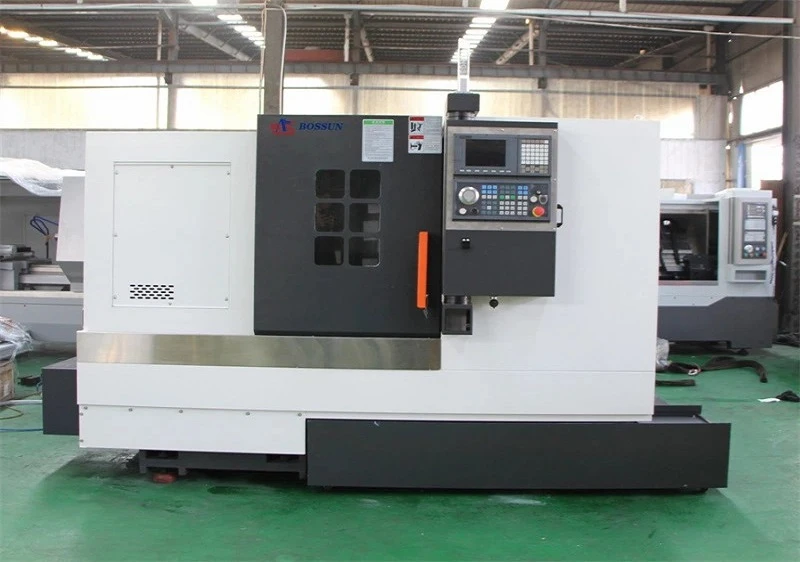
It has 30-degree inclined bed saddle structure and rolling guide rail design and the overall funnel-type bed structure is more suitable for automatic line layout.

75 Degree Inclined Bed Heavy Metal Equipment
The X/Z axis screws are all pre-stretched structures, which can reduce the impact of temperature rise on screw accuracy during processing, and use high-speed and silent ball screws;

Efficient Turning And Milling Center
It can achieve up to four-axis linkage of X, Y, Z, and C, and can process eccentric holes and mill wide slots and can be configured with dual spindles, dual tool holders, and programmable servo tailstock.

Pipe thread lathes have a variety of spindle diameters for a wide range of applications, and can provide a variety of hydraulic center frames.

E overall bed of Tilt CNC lathe has an inclined structure, which has good rigidity and stability, and has higher rapid movement speed and efficiency.

The linear guide CNC lathe is designed with an overall tilt of 45°, which has the characteristics of high rigidity and smoother cutting.
Spindles with high torque and speed ensure fast, accurate, and aggressive metal removal
Second spindles offer rear finishing or sequential part processing
Rotary tool spindles ensure milling, drilling, and tapping performance in the machining center
Double spindle and double turret configurations provide innovative parts machining options
Full-circumference headstock brakes design
The Y-axis function offers a larger machining range for part geometry
Strong, built-in NC-controlled tailstock allow for automated processes
Hybrid roller guides provide durability and reliability for long-term accuracy
Optional deep hole drilling in boring bars ensures extremely productive machining
User-friendly, high functionality CNC control simplifies programming and increases productivity
Compliance of the bar feeder, gate loader, and articulated robot increases production and allows switching off lighting

What are the Different Types of Turning?
Straight Turning
Straight turning involves the removal of metal from the external surface of a cylindrical workpiece. The cutting tool moves longitudinally along the workpiece, reducing its diameter. It is often used to ensure cylindrical workpieces have a consistent diameter along their length.
Taper Turning
In taper turning, the tool is not parallel to the axis of the lathe, but at an angle, allowing for the creation of conical shapes. This technique is commonly used to create machine tool spindles and drive shafts that require a tapered end for fitting components.
Facing
This operation involves reducing the length of a workpiece or creating a smooth end or face. The cutting tool moves radially across the end of the workpiece, removing material. It's used frequently to clean up the ends of parts or prepare surfaces for additional machining processes.
Parting
Parting or cutoff is the operation of cutting off a piece from a larger workpiece. It involves the creation of a narrow slot down to the center of the workpiece, ultimately separating a section of material. It is typically the final operation after the part is fully shaped.
Groove Turning (or Grooving)
This type involves cutting a narrow groove on the external or internal surface of the workpiece. Groove turning is commonly used for oil grooves, retaining ring grooves, and for parting off sections of a workpiece.
Thread Turning
This type involves cutting a helical groove of a particular pitch along the external or internal surface of a cylindrical workpiece. Thread turning is used to make screw threads for fasteners and other components requiring threaded features.
Boring
Boring is the process of enlarging a hole that has already been drilled or cored. It can improve hole accuracy and provide a smooth internal surface. It's used for finishing internal surfaces or preparing them for additional operations like thread turning.
Knurling
This operation produces a regularly shaped roughness on the workpiece surface, often to provide a better grip for handling. The knurling tool presses a pattern into the surface of the workpiece as it rotates.
Drilling
In a lathe, drilling is the operation of making a cylindrical hole by removing metal along the circumference of a pointed tool or drill bit. It's typically the first step in creating an internal feature that will be further refined by operations like boring or thread turning.
CNC (Computer Numerical Control) Turning
CNC turning employs computer programs to control the cutting tool's motion. It enables the creation of complex parts at high speeds and with high precision. CNC turning is particularly useful for producing parts with complex radial features or when tight tolerances are required
Turning Center Components
The bed is the base of any machine tool and that is also true for the lathe and turning center. The other components of the turning center are mounted onto the bed, such as headstock, tailstock, slideways/cross slide. The rigidity of the bed is very important for machining accuracy, which is why it is often just one-piece cast iron. The turret and other components ride along the slideways or box ways alongside the bed.
The carriage is the component that provides support for the turret with the cutting tools the guideways and the feeding mechanism that is used to move the cutting tool against the workpiece. Its main parts are the saddle, cross-slide, and of course, the turret. Turning centers with live (driven) tool turrets can perform additional milling operations which makes them even more flexible.
Turning center headstockThe headstock incorporates the main spindle with the jaw chuck that holds the workpiece in place. The maximum diameter of the workpiece is determined by the spindle bore size. Traditionally, the headstock is located on the left side of the turning center. If you are using a chuck then the headstock can handle larger workpieces than could be fed through the spindle but you will be limited to automated part handling.
Turning center tailstockThe tailstock is located opposite of the headstock, usually on the right side of the turning center's worktable. The main function of the tailstock is to give support to longer workpieces during the cutting operation. Therefore its position can be adjusted along the x-axis (also called lateral axis).
Turning center headstockThe turret of a turning center holds multiple cutting tools and changes them if necessary by rotating around its axis. It is a small automatic tool changer.
What are the Technical Differences between Lathes and Turning Centers?
There is no hard and fast rule for making the distinction. Further muddying the waters is that CNC turning centers and lathes often look alike. Still, they usually refer to entirely different machines. Whether the lathe is a manual or CNC lathe, if it is capable of only two-axis (X and Z axes) machining, it is considered a lathe. The machine can perform operations including turning, facing, threading, knurling, drilling with the tailstock, boring, reaming, and taper turning. Still, each of these requires only the two axes and single spindles that are part of a lathe.
Lathes that include 3-axis, 4-axis, and 5-axis capabilities are known as turning centers, and they are an "evolutionary leap" from the CNC and manual lathes of the past. While traditional lathes rotate a workpiece as a cutting tool removes material to create a round part, multi-axis turning centers are far more versatile in their cutting ability. Adding the extra axes and twin spindles allows turning centers to perform operations beyond a traditional lathe's capabilities.
Turning centers have cutting tool turrets for automated tool changing, live tooling, efficient chip removal, and a fully enclosed design for added safety and to keep high-speed coolant inside. Using sub-spindles for milling and drilling on multiple axes allows parts to be completed in one setup, eliminating the need to remove a workpiece for secondary operations on another machine.
CNC lathes and CNC turning centers: what is the difference?
Although there is no formal distinction between lathes and turning centers, the former term is commonly used to refer only to simpler machines – designed for CNC turning operations alone. By contrast, the term "turning center" usually refers to machines that integrate milling or drilling capabilities or those with counter spindles to perform operations on the other side of the part.
A CNC lathe is simply turning; it's a 2-axis machine with X and Z axes with only one chuck. Opposite the chuck may be a tailstock to support the part, or in simpler designs, there is only the chuck itself.
A CNC turning center can incorporate milling capabilities, a secondary spindle, and a Y-axis to expand functionality. They are also called multi-tasking machines because they offer more than CNC turning. You can think of it as an evolution of the lathe. In the past, most people called such machines lathes. Still, as CNC machining became more complicated, they evolved into CNC turning centers after adding milling and counter spindles.
Our Factory
Common Problems of Heavy Turing Center
Hot Tags: heavy turning center, China heavy turning center suppliers, factory, Roller Linear Rail Vertical Machining Center, Single Column Vertical Lathe, 10 Ton Heavy Duty Horizontal CNC Lathe, 16 Ton Heavy Duty Horizontal CNC Lathe, CNC Vertical Lathe Grinder, Gantry Type Heavy Cutting Machining Center